


Overview
A versatile 4-mic array for robots and embodied AI applications like smart signage.
Powered by XMOS XVF3800, it features on-board AI acoustic algorithms such as AEC, beamforming, and noise suppression.
With a split design and options for circular or linear mic arrays, it supports both dual modes(I2S/USB), making it the smart ear for embodied AI projects requiring far-field and clear voice capture.
Key features
Explore the full lineup. Compare specs, find your ideal fit, and catch the latest updates & community news. Check the Series Landing Page
Note:
- The Flex with no versions (100005504, 100099135) come with factory-installed USB audio firmware.
- The Flex with ESP32S3 versions (100070894, 100026178) come with factory-installed I2S firmware for MCU integration.
- All 4 versions support DFU mode for users to switch the firmware.
- To ensure optimal voice pickup performance, please make sure the Microphone Port on the back side of the device is facing toward the sound source. The microphone port is located on the side with the logo printed on it. For detailed placement guidance, please scroll down to Feature 5 to view the illustration.
Feature 1: Innovative Modular SplitDesign
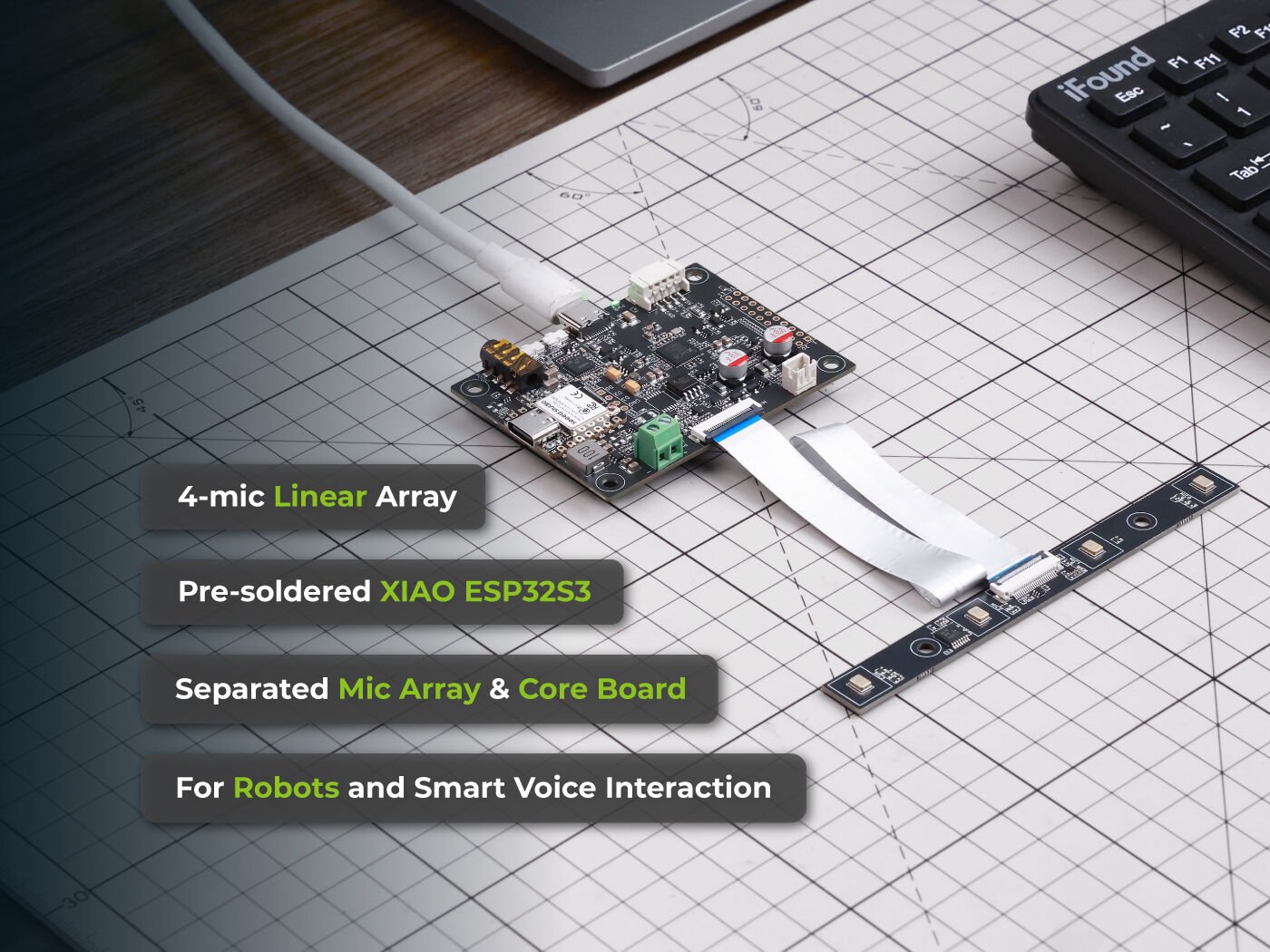
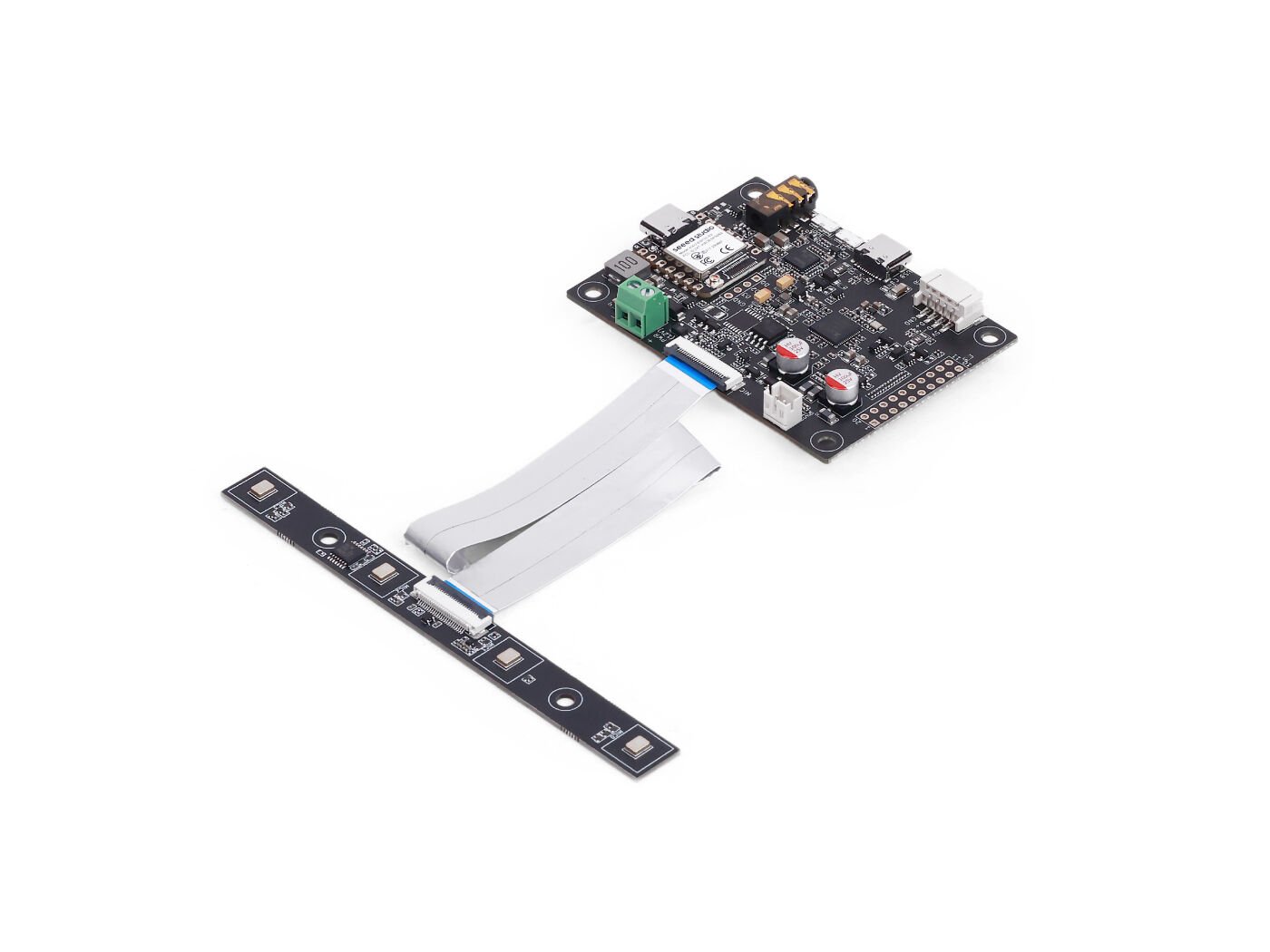
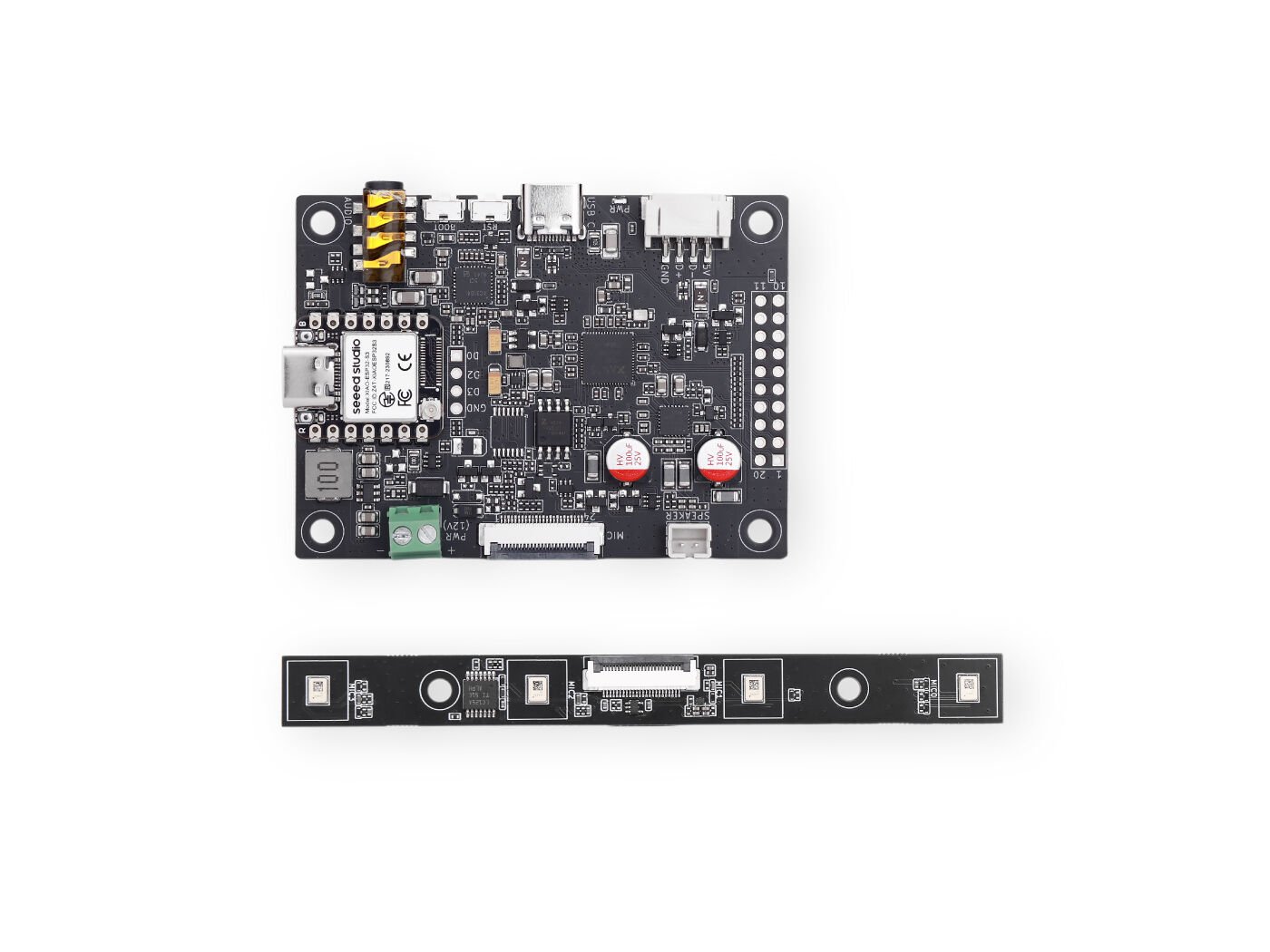
Separates the core processing board from the microphone array board via a flexible FPC cable, enabling easy integration in space-constrained robotics and embedded applications.
For use cases such as desktop or humanoid robots, the mic array board can be positioned near the sound source, while the core board can be placed elsewhere inside the device. This design helps minimize interference from internal motor and servo noise, resulting in improved voice capture performance.
Feature 2: Flexible Array Configurations
Available in two standard configurations: 4-mic circular array for 360° spatial pickup, and 4-mic linear array for 180° directional pickup.
- In robotics applications, the circular array can be mounted on the robot’s head for omnidirectional voice capture.
- For smart digital signage, the linear array is well-suited for front-facing placement, optimizing voice pickup for typical user interactions directly in front of the display.
Feature 3: XMOS XVF3800 for Advanced AI Audio Processing
on-board AI acoustic algorithms for better sound quality. Features AEC, multi-beamforming, de-reverberation, DoA, dynamic noise suppression, AGC, delivering stable and reliable voice capture performance.
- AEC (Acoustic Echo Cancellation)
AEC removes acoustic echo caused when sound played from the system is picked up again by the microphone array. AEC is critical in full-duplex communication systems such as conferencing devices, voice assistants, and interactive systems.
- NS (Noise Suppression)
NS reduces unwanted background noise from captured audio. By identifying and attenuating non-speech components, such as fan noise, motor and servo noise, ambient chatter, keyboard typing, or environmental hum, NS enhances the SNR (signal-to-noise ratio) in real time.
NS is essential in voice interactive systems including smart home and industrial voice control, voice assistants, educational devices, smart interactive terminals, and robots.
Feature 4: Powerful Far-Field Voice Capture
With far-field voice capture up to 5 meters and the circular 4-microphone array (100005504, 100070894) supporting precise Direction of Arrival (DoA) detection, the Flex delivers reliable voice capture and accurate sound source localization for interactive and voice-driven applications.
- Far-field Voice Capture Up to 5m
This enables clear command recognition in larger spaces without requiring users to stand close to the device, making the Flex ideal for voice interactive setups like smart digital signage.
- Circular 4-Microphone Array Supports 360° DoA
The circular 4-mic array enables accurate 360° DoA detection, allowing the Flex to identify where a voice is coming from. This spatial awareness enhances interaction performance, supports speaker tracking, provides a strong foundation for advanced beamforming, and allows users to interact with the robot from anywhere around it.
Feature 5: Compact Design for Embedded Applications
- Bottom-Firing Microphones
The acoustic ports are positioned on the back side of the mic array board, reducing interference from front-facing components. This design also allows the microphones to be placed closer to the sound source or device surface, maximizing voice pickup performance.
- The microphone port is located on the side with the logo printed on it.
- Please make sure the Microphone Port (Mic Inlet / Sound Hole) on the back side of the device is facing toward the sound source.
- For embedded deployments such as integrating the inside robots: Mount the microphone port as close as possible to the robot’s outer surface and orient it toward sound sources. This minimizes interference from internal mechanical and electronic noise during audio capture. Cut matching sound pickup openings on the robot casing aligned with the microphone port. Fully sealed enclosures will degrade audio recording performance.
- Compact Size, Powerful Performance
With just 44 mm mic spacing and a diameter of 73 mm for the circular array, and 33 mm spacing with a length of 110 mm for the linear array, the design fits easily into space-constrained embedded applications. Despite its compact size, it delivers outstanding voice capture performance, achieved through the combination of optimized hardware design and acoustic tuning.
Feature 6: Developer-Friendly Integration
The Flex with no versions (100005504, 100099135) come with factory-installed USB firmware.
The Flex with ESP32S3 versions (100070894, 100026178) come with factory-installed I2S firmware.
- Plug-and-Play via USB: A standard USB interface enables quick connection to devices such as Raspberry Pi, NVIDIA Jetson, and PCs running Windows, Linux, or macOS, no drivers or complex setup required.
- I2S for MCU Integration: Direct I2S support allows seamless integration with MCU platforms like the Series and Arduino, making it easy to build embedded voice-enabled applications with minimal hardware overhead.
- ESP32S3 Pre-Soldered Options: Two variants (100070894, 100026178) come with a pre-soldered ESP32S3, enabling native support for ecosystems such as ESPHome and Home Assistant. This allows developers to easily extend applications into smart home scenarios and beyond.
Feature 7: Fast, Scalable, and Customizable for Production
Studio offers customization services include hardware modifications such as adjusting the size or shape of the microphone array board to better fit space-constrained robotics and embedded voice interaction scenarios. Algorithm tuning is also available to further optimize audio performance. For reference, similar approaches have been applied in open-source projects like the Reachy Mini desktop robot.
Specification
Core Board
Feature | Description |
|---|---|
Core Chip | XMOS XVF3800 |
Amplifier | Texas Instruments TPA3139D2, Supports 10W Speakers |
Audio Algorithms | AEC, AGC, DoA, Beamforming, VAD, Noise Suppression, De-reverberation |
USB Interfaces | 1x USB Type-C, For external connection and debugging; 1x USB JST Connector, For internal routing and motherboard integration; |
Other Interfaces | 1x Compatible Pads; 1x XMOS XVF3800 XTAG Debug Pads; 1x XMOS XVF3800 io Pads; |
Audio Outputs | 1x 3.5mm Audio Jack; 1x 2-Pin Speaker Connector; |
Power Supply | 5V Input: Via USB Type-C or 5V JST Connector; 12V Input: Via 2-Pin Terminal 12V Connector; |
Mic Array Interface | 1x 24-Pin FPC Connector |
Button | 1x Reset Button; 1x Boot Button; |
Maximum Sampling Rate | 16kHz |
Mic Array Board
Feature | Description |
|---|---|
Microphone | 4x High-performance PDM MEMS microphones |
Array Topology | 33 mm spacing arranged Linear Mic Array |
Pickup Pattern | 180° directional audio capture |
Pickup Range | Up to 5 meters |
Interface | 1x 24-Pin FPC connector |
Mounting | 2 × M3 mounting holes |
Application
Application 1: Robotics Integration with Flex
Its compact microphone array can be placed on a robot’s head, ears, forehead, chest, or even externally (e.g., on a robotic arm) to capture sound closer to the source, while the core processing board remains safely inside the device enclosure. Combined with strong customization capabilities, it enables seamless integration into a wide range of robotic platforms, including humanoid robots, desktop robots, companion robots, service robots, and robot pets such as robot dogs.
With support for ROS2, it streamlines system-level communication and development. Powered by the XMOS XVF3800 audio processor, Flex features on-board AI acoustic algorithms such as multi-beamforming and advanced noise suppression, enabling reliable wake word detection, speech-to-text (STT), speech-to-intent, voice command recognition, and other voice AI workflows.
An upgraded design supports a 10W amplifier, enabling strong text-to-speech (TTS) performance and delivering clear, natural voice interaction even in larger spaces.
- Add Voice Interface to LeKiwi Robot with Flex
This project combines a ESP32 (motor controller) with a Raspberry Pi (voice processing brain), enhanced by the Flex for high-quality audio capture and Voice Embeddings for smarter, more personalized voice interaction. Using natural language commands, you can drive, steer, and control the robot completely hands-free with improved accuracy and responsiveness.
- Voice Control reBot Arm B601-DM with Flex
We built a voice-driven intelligent robot arm control system from scratch. Now with Flex, the reBot Arm can listen and capture your voice while identifying which direction the sound is coming from. Then it can understand what you say and understand your intention. Finaly it can make corresponding actions accordingly (turn, nod, dance, wave, etc.)
Application 2: Build Private Secured Smart Toys withFlexfor Intuitive Voice Interaction
Its compact and flexible microphone array can be seamlessly embedded into various toy form factors such as plush toys, educational devices, or handheld companions, allowing it to capture user’s voices accurately even in dynamic and noisy environments.
Leveraging the XMOS XVF3800 audio processor, Flex enables more responsive and engaging interactions, from voice-controlled storytelling and learning activities to conversational AI companions.
With support for locally running voice agents, Flex enables on-device processing of voice data, helping safeguard user privacy, especially important for companion toys and child-focused applications.
Application 3: Build Smart Voice Terminals with Seamless and Reliable Interaction
Flex brings reliable and intuitive interaction to self-service kiosks, smart vending machines, and smart digital signage. Its linear microphone array options (100099135, 100026178) are optimized for seamless integration into narrow screen bezels(e.g., screen edges, display frame) and compact enclosures, without compromising acoustic performance.
It delivers advanced noise suppression and directional far-field voice capture (up to 5m), ensuring accurate speech recognition even in acoustically challenging public and larger environments such as malls, transit hubs, and retail spaces. This enables faster, touch-free user interactions and improves overall accessibility.
Application 4: Build Physical AI Voice Agent with Flex
Through SDK and platform compatibility, Flex supports rapid integration with voice AI frameworks and cloud-based services, allowing devices to be quickly transformed into scalable voice agent solutions.
Application 5: Build Smart Voice Assistants Using Flex
Seamlessly integrates with Amazon Alexa, Google Assistant, Home Assistant, and other mainstream voice platforms for far-field voice control and smart home automation.
Application 6: Smart Conference Solutions Using Flex
Compatible with Microsoft Teams, Zoom, and other popular conferencing software via USB. 4-mic array supports beamforming and DoA detection to deliver clear multi-person audio pickup and real-time status feedback.
Application 7: Industrial Voice Control
Designed for demanding environments, Flex enables reliable voice command control across factories, retail, and commercial settings. With advanced noise suppression, it maintains high recognition accuracy even amid machinery noise and complex acoustic conditions, supporting efficient, hands-free operation.
Part list
Flex Core Board | x 1 |
Flex Linear Mic Array Board | x 1 |
20cm FPC Cable | x 1 |
Pin Connectors | x 1 |



Reviews
There are no reviews yet.